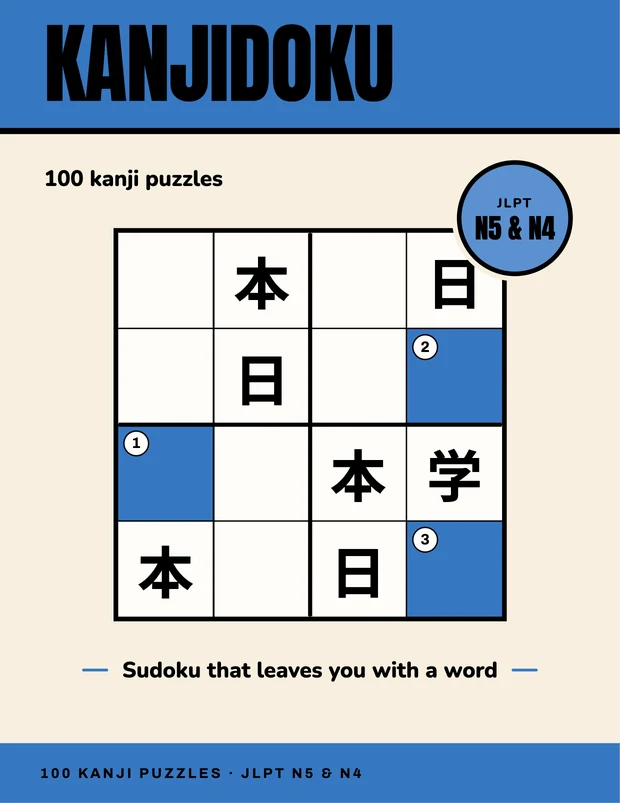
Sudoku that leaves you with a word.
The whole idea
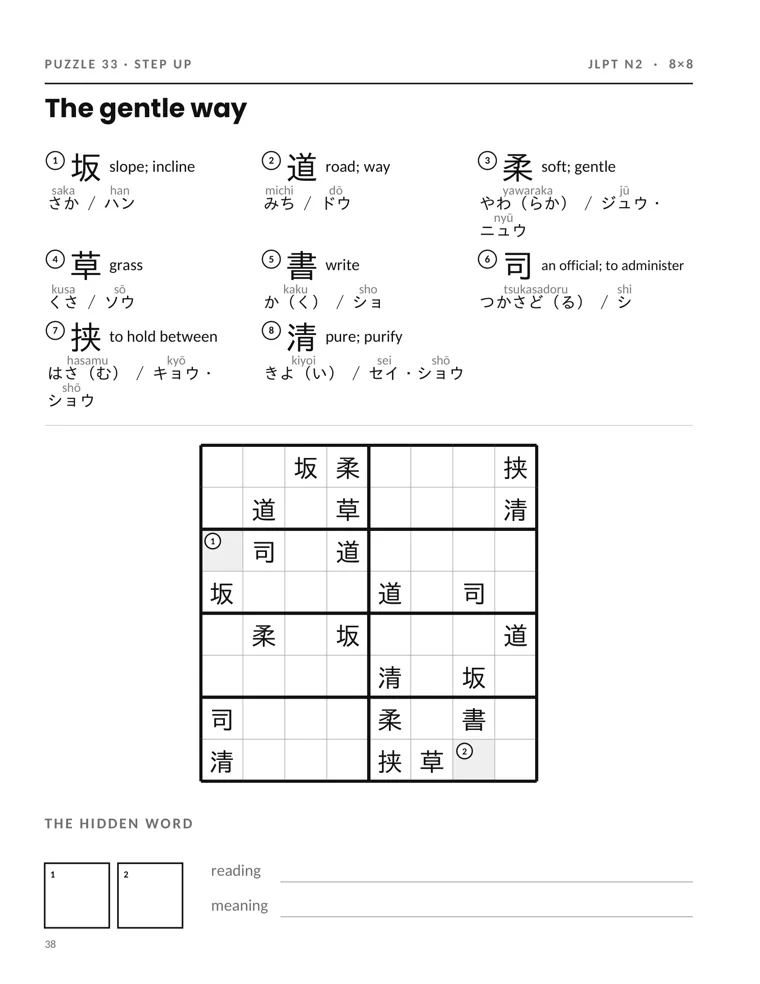
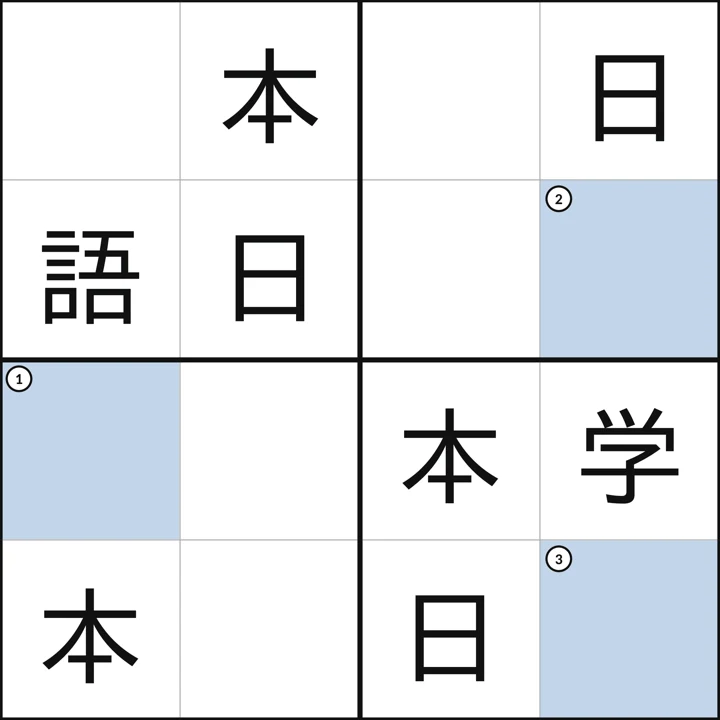
Every row, every column and every box holds each character exactly once: the sudoku rule, unchanged. You don't need to know what a character means to solve a grid. A symbol is a symbol.
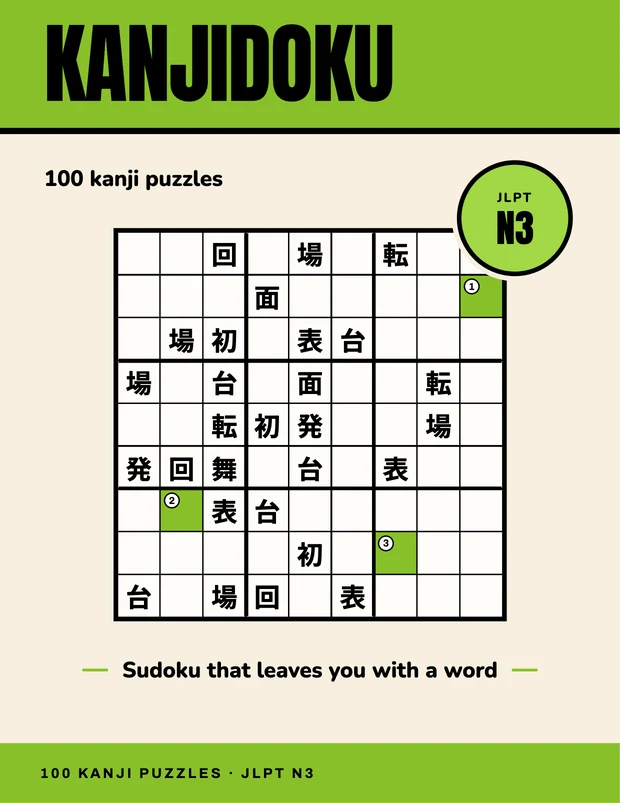
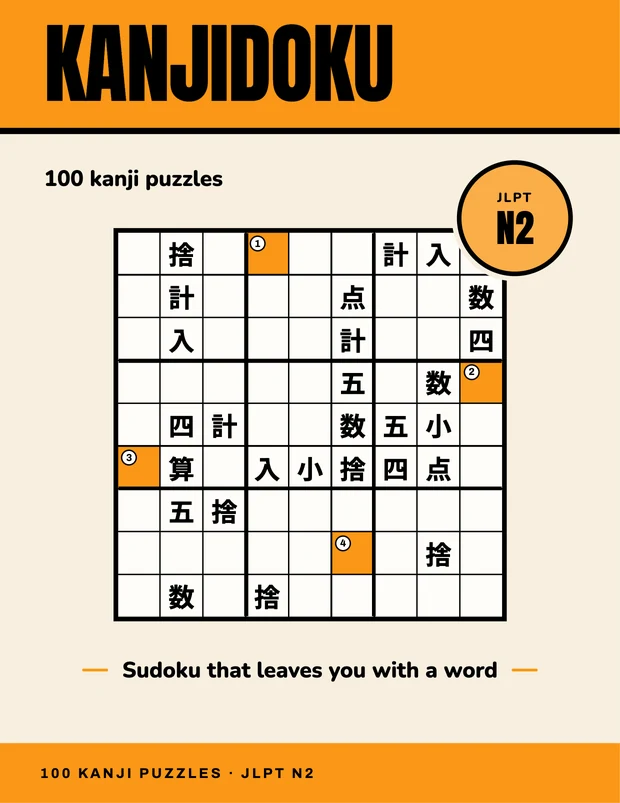
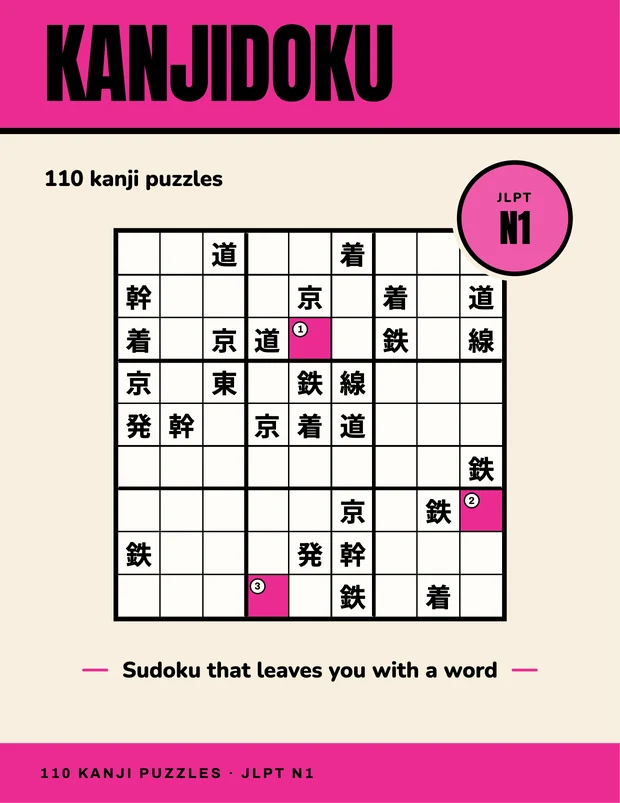
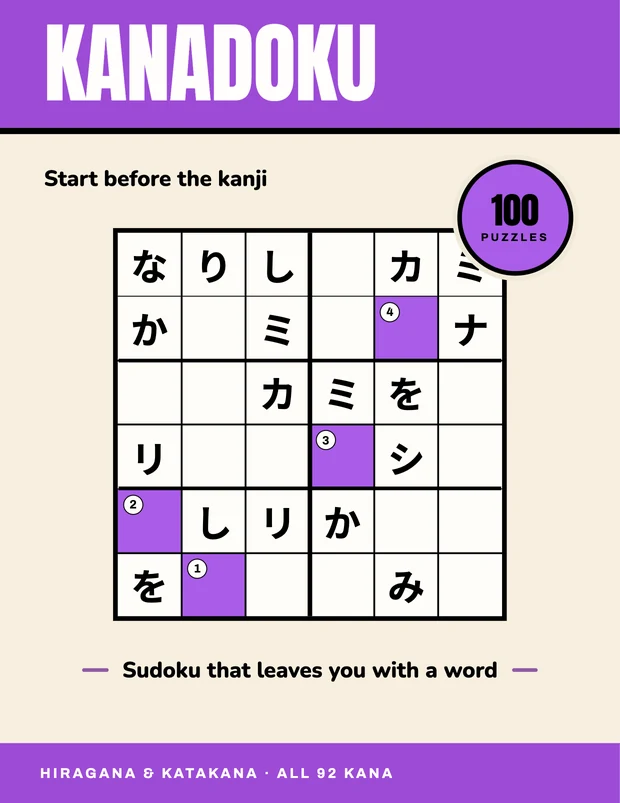
But two, three or four cells start shaded and empty. Fill the grid, read them in order, and they spell a real Japanese word built from the characters you have just spent twenty minutes with. The puzzle is the lock. The vocabulary is the reward.
Nobody learns a character by looking at it. You learn it by needing it, nine times, in nine different places, before the grid will close.
How a puzzle goes
Every character in the grid is printed above it with its readings, its meaning and romaji. You never turn back a page to look something up.
Pure logic, every time. No puzzle in any of these books needs a guess, and none needs a technique beyond naked and hidden singles.
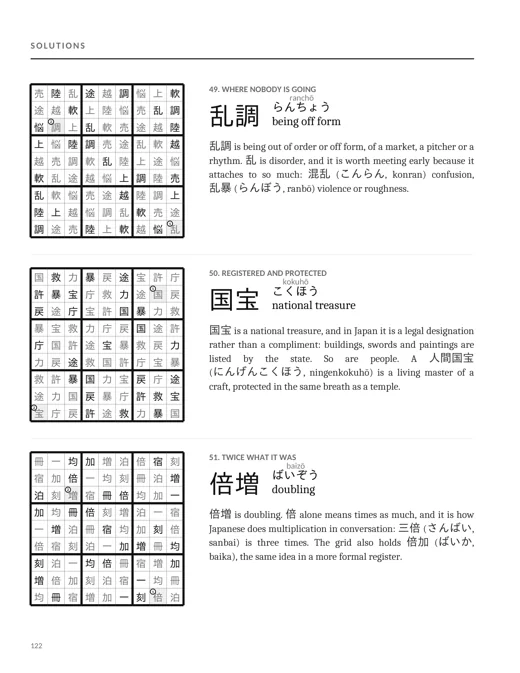
In numbered order, they spell a word. Write it in the space provided, along with its reading and its meaning. You can always check the solution in the back, so give it a guess if you are not sure.
The series
The series starts at the beginner JLPT N5 and N4 levels and builds up to N1, which covers the 500 commonest kanji at that level. So you learn kanji in order of difficulty, and within a level by how often they actually turn up. Considering that the top 1,000 kanji, much the same set as the 教育漢字 Japanese children learn in elementary school, cover over 90% of their general usage, you’ll cover a lot of ground.
Levels are drawn from KANJIDIC's frequency data, and each book says so in its front matter: the JLPT has published no official kanji list since 2010, so every list in circulation is somebody's reconstruction.
Six 4×4 warm-ups open the book. Grids grow to 6×6, 8×8 and a full 9×9.
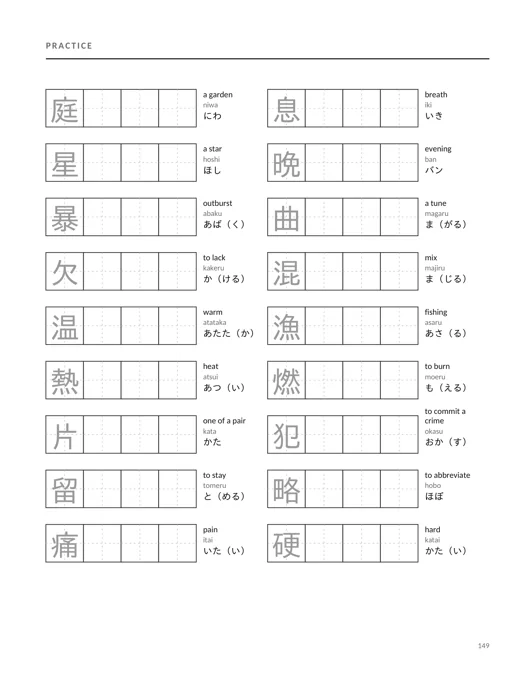
Open it on day one. The warm-up grids ask nothing but pattern matching, and every character you need is defined on the page in front of you. By the end you have handled all 246 characters of both beginner levels, and written each of them out multiple times.
No warm-ups. Grids open at 6×6 and run to a full 9×9.
N3 is the intermediate wall. The grammar that made you feel fast is behind you, and what is left is vocabulary and kanji, arriving slowly. Every piece of advice amounts to more flashcards. This is 4,101 squares of handwriting that do not feel like handwriting, and a finished grid is finished in a way a deck never is.
Fewer given squares than either book before it.
N5 is curiosity and N3 is a plateau. N2 is the one employers name in a job posting when they hire from abroad, and the level two out of three candidates fail. Thirteen of the grids hide a four-character phrase. No other kanji puzzle book does that, because none of them has a mechanic that could carry one.
110 puzzles, the most in the series, and sixty of them full 9×9 grids at the leanest given counts anywhere in these books.
N2 is the level employers name. N1 is the only one that is a requirement rather than a preference: a doctor or a nurse licensed abroad needs it before they are allowed to sit Japan's own examinations, and fewer than three in ten who take it pass. Around two thousand characters, cumulative, which is where learning by attrition stops working and needing a character starts to matter.
No writing-practice pages in this one. It assumes you can already write, and spends those pages on ten more puzzles instead. The tracing is in Volumes One to Three. The stroke orders for all 705 characters are free to download.
Hiragana, then katakana, then both at once.
Not ready to take off the training wheels just yet? Kanadoku's got you covered. The same mechanic played with kana, for a reader who has not met a kanji yet. Start with hiragana, then move on to katakana. In the third part, move on to grids that mix both scripts; the value being the sound. Meaning kana with the same sound, like あ and ア, cannot share a row.
Free
Every sampler is twelve pages taken straight from the finished book: how to play, the hidden-word mechanic worked through on a real grid, five puzzles that climb from the smallest grid to a full 9×9, the solution and the note for each of those five, and a page of writing practice. Volume Four’s runs to eleven, since that book has no writing practice to sample. Print it and solve it. Nothing is asked of you in return.
A 4×4 warm-up, a 6×6, a 5×5 jigsaw and two full 9×9s. It opens on the grid that spells 日本語 and closes on 試験.
Download PDFA 6×6, a 7×7 jigsaw, an 8×8 and two full 9×9 grids, closing on 初舞台.
Download PDFA 6×6, a 7×7 jigsaw, an 8×8 and two full 9×9s, including the grid whose four shaded cells hide 四捨五入.
Download PDFA 6×6, an 8×8, a 7×7 jigsaw and two full 9×9s, including the grid that hides 新幹線.
Download PDFA 4×4 opener, a 5×5 jigsaw, a 6×6 and two full 9×9s: one all katakana, one mixing both scripts. It closes on こんにちは.
Stroke-order references are free too, one per volume: every character in the book drawn large, with the order to draw it in. Get them here.
Inside
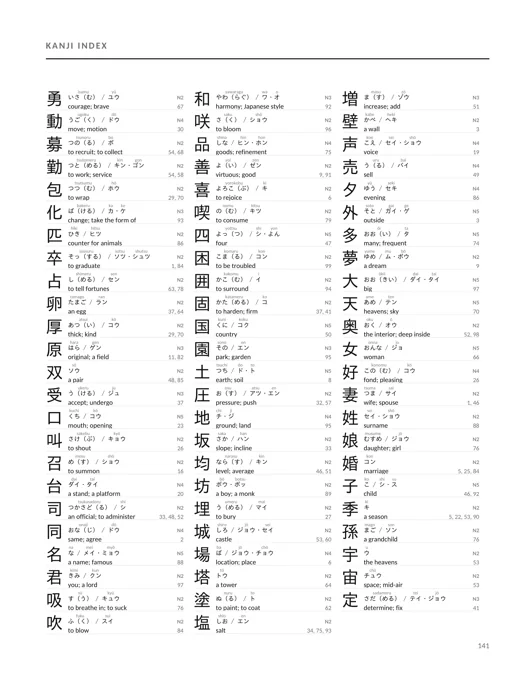
The two complaints that come up again and again in reviews of kanji workbooks are that there is no index and no stroke-order guide. Every volume indexes every character it contains. Stroke order used to be squeezed into the practice squares; it now has a free document of its own, one per volume, where it can actually be read.


Why the grids can be trusted
Every grid is proved before it reaches a page. Three of those promises are the ones you actually feel while solving.
Made by someone who did the hours
The creator lived in Japan for twelve years and is fluent in the language. Which also means twelve years of knowing exactly how it feels: characters looked up countless times that still will not stick, a wall plastered with handwritten kanji index cards, the point where a textbook stops being a help and starts being furniture.
That is the whole reason these books work the way they do. A grid never asks you to memorise anything. It asks you to use a character until the puzzle closes, then hands you a word for your trouble.
It makes for a great supplement to your other learning materials. Which is why it sits alongside your textbook rather than competing with it, and why people finish one and start another.