Mind Quests
← Kanjidoku

Stroke order

Every character in the book, big enough to read.


Why this exists

Taken out of the books, so it could be big enough to use.

The practice pages used to carry the stroke order themselves: a grey model in a small square, with a number at the start of every stroke. On paper those numbers came out about a millimetre tall, light grey on cream, and nobody was reading them.

Setting them larger inside the book was not the answer either, because on a dense character the numbers crowd each other rather than the page. So stroke order came out of the books altogether and was given a document of its own. The practice squares now hold a clean model to trace. The numbers live here, at 128pt, where every one of them can be read.
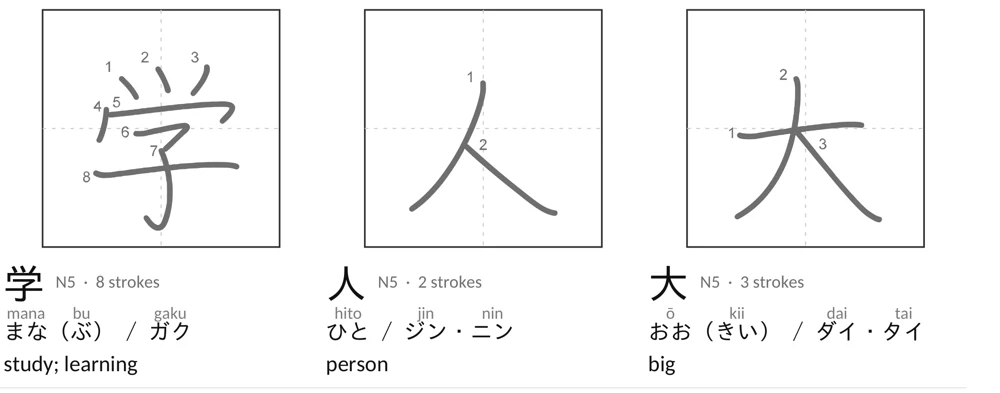
Three entries from the supplement: 学, 人 and 大, each drawn large with every stroke numbered, with level, stroke count, readings and meaning beneath.
Three entries at actual proportions. Model, printed form, level, stroke count, readings with romaji, meaning.

What is in one

A reference, not a workbook.

There are no tracing boxes. The books already have those, and repeating them here would double the page count for nothing. What this adds is every character in that volume, drawn once, large, with the order to draw it in, so you can look up anything you have met.

Three pages open it: how to read the diagrams and the two rules that cover most characters, then 言 built one stroke at a time, and the thing nobody tells beginners early enough, which is that the printed shape and the written shape are not quite the same. What changes is the shape of a mark, never the order, so the numbers hold either way.

Then the characters, nine to a page, easiest level first and within a level by how often it turns up in that book.

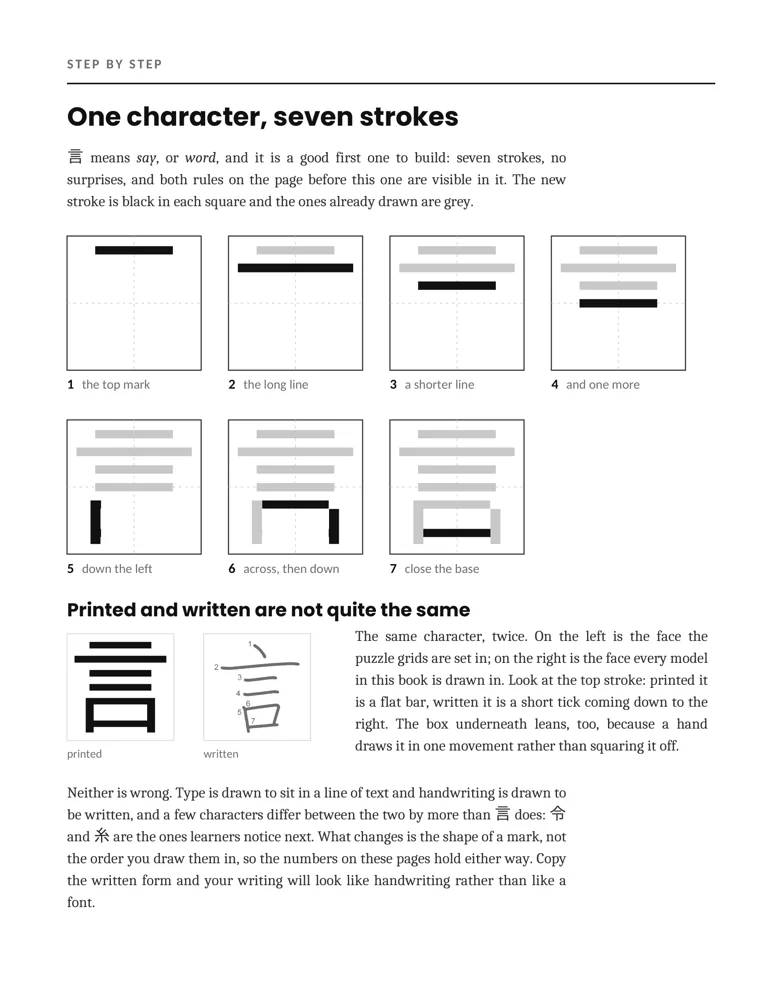
The worked-example page: 言 built one stroke at a time across seven frames, then printed and written forms compared.
Page three: one character, seven strokes
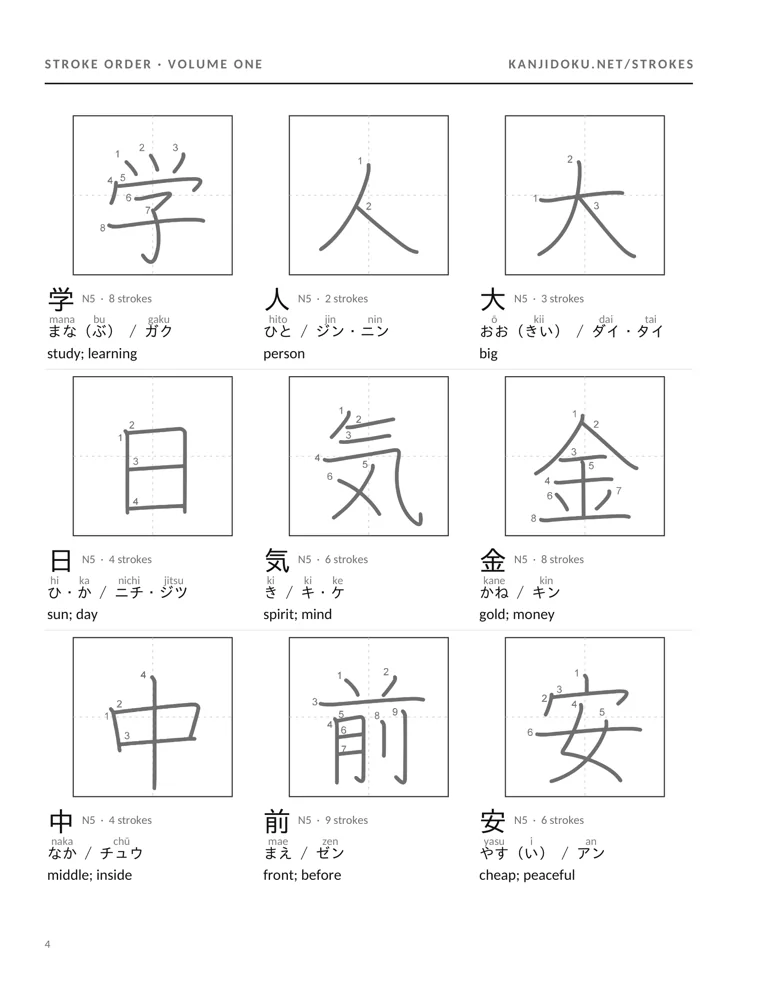
A body page of the supplement: nine characters in three columns, each drawn large with numbered strokes.
A body page: nine characters, three columns

Download

One per volume. Free.

8.5 × 11, the same trim as the books, with margins safe on any home printer. Pick the volume you are working through.

Volume One · JLPT N5 & N4

246 characters

32 pages · 8.5 × 11

The characters run in the same order as the writing practice at the back of the book, so the two can sit side by side.

0.6 MB
Download PDF
Volume Two · JLPT N3

497 characters

60 pages · 8.5 × 11

Every character in the book, including the easier ones carried over from Volume One, which the practice section does not drill.

1.1 MB
Download PDF
Volume Three · JLPT N2

562 characters

67 pages · 8.5 × 11

Every character in the book, including the earlier levels borrowed where a theme wanted one.

1.2 MB
Download PDF
Volume Four · JLPT N1

705 characters

83 pages · 8.5 × 11

Volume Four has no writing-practice pages: it spent them on ten more puzzles. This is where its stroke orders live, and it is the volume this matters most to.

1.5 MB
Download PDF
Kanadoku · Hiragana & katakana

92 characters

16 pages · 8.5 × 11

Every kana in both alphabets, with the marks that change a sound and the long bar. Kanadoku's own practice pages gave up their models, because at 40pt nobody could read the numbers.

0.3 MB
Download PDF

Using them

Free to print and to share, whole and unmodified, including by teachers with a class. Not to be sold. If they are useful to somebody, pass them on.

Models are set in the KanjiStrokeOrders font, used under its BSD-3 licence. Stroke counts come from KANJIDIC.